
Written by: Feroz Mansoor
MSK Physiotherapist
Stride Lab London
Clinically reviewed: August 2026
Running assessments have become increasingly sophisticated.
A modern running assessment may include slow-motion video, treadmill analysis, wearable sensors, cadence measurement, strength testing and evaluation of training history.
But what does all of this data actually tell us?
Can a running assessment identify why your knee hurts after 10 km? Can it tell you whether you are overstriding? Can changing your cadence reduce load through a painful knee? And perhaps most importantly:
Can a running assessment predict whether you will become injured?
The scientific answer is more nuanced than many runners are led to believe.
Running biomechanics can provide useful information — particularly when they are interpreted alongside a runner’s symptoms, injury history, strength and training load.
However, there is no single “perfect” running style and no movement pattern that reliably identifies who will or will not become injured.
A good running assessment should therefore not simply produce a list of biomechanical “faults”.
It should answer a more useful question:
Is there anything about this runner’s strength, training or running mechanics that appears relevant to their symptoms or goals — and can we meaningfully change it?
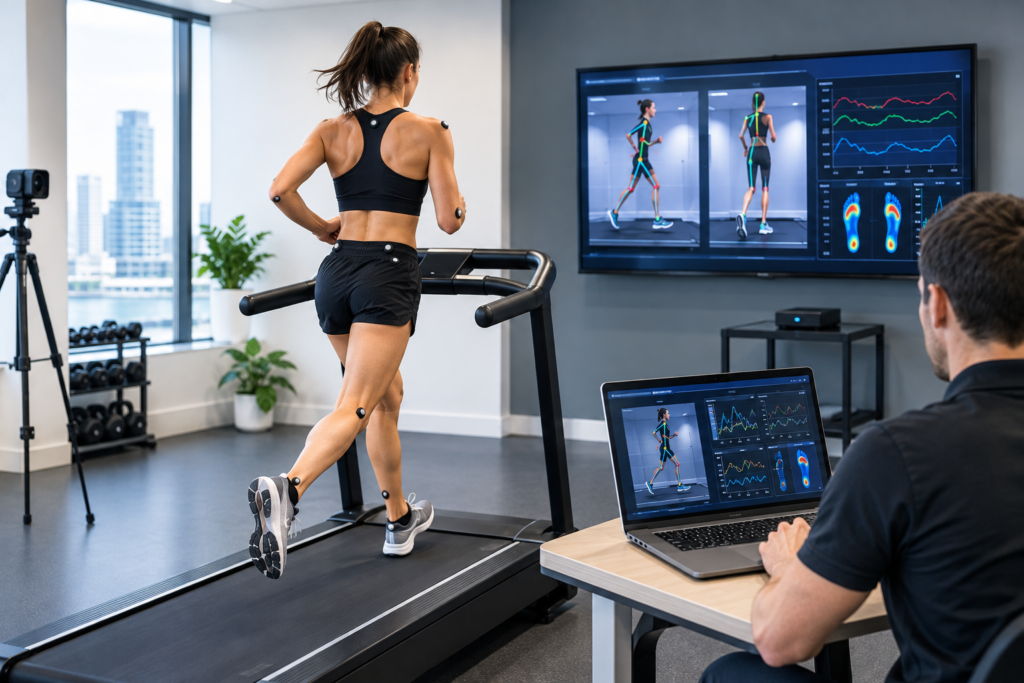
A comprehensive running assessment looks at the runner rather than simply watching their feet on a treadmill.
Depending on the reason for assessment, it may include:
This distinction is important.
Running gait analysis is one component of a running assessment — not the whole assessment.
A runner with knee pain following a rapid increase in marathon mileage may require a very different intervention from an injury-free runner trying to improve running efficiency.
Before looking at video or sensor data, perhaps the most important question is:
What changed?
Running injuries are multifactorial.
Training volume, intensity, previous injury, recovery, strength, sleep, nutrition and biomechanics can all contribute.
One of the most consistently identified risk factors for future running injury is actually previous injury, rather than a particular foot strike or running style.
A systematic review of prospective research into running-related injury risk factors found previous injury to be the most frequently identified risk factor.
A later systematic review examining overuse injuries in short- and long-distance runners similarly identified previous running-related injury as one of the strongest risk factors in long-distance runners.
This is why a running assessment should begin with questions such as:
The treadmill comes afterwards.
Runners are frequently told never to increase their mileage by more than 10% per week.
The science is not that simple.
A systematic review examining changes in training load and running-related injury found some evidence that sudden changes in running distance, speed or frequency may be associated with injury, but overall evidence was limited.
For example, increasing from 20 to 22 miles per week may represent a 10% increase.
But adding:
at the same time could substantially increase the overall physical demand without producing a dramatic change in weekly mileage.
A good running assessment therefore considers what the runner has recently been exposed to, rather than blindly applying one percentage rule.
If your knee pain repeatedly returns when mileage increases, prevents you reaching your normal running distance or you are unsure whether the problem is runner’s knee, IT band pain or another condition, a running-specific assessment can help establish the likely cause.
Contact Stride Lab London to book a running physio assessment.
Slow-motion video allows a clinician to observe movement frame by frame.
Depending on camera position and software, measurements may include:
Video analysis can therefore reveal patterns that may be difficult to appreciate when watching someone run at normal speed.
A widely cited clinical paper by Richard Souza described an evidence-based approach to video running biomechanics analysis, demonstrating how relatively accessible two-dimensional video can be used to evaluate clinically relevant running characteristics.
However, there is an important limitation.
Seeing a movement pattern does not prove that it caused an injury.
The most sophisticated biomechanics laboratories use three-dimensional motion capture systems.
These systems use multiple cameras and reflective markers to calculate movement in three dimensions.
Clinical running assessments more commonly use two-dimensional video because it is faster, more accessible and considerably less expensive.
How reliable is it?
A 2022 systematic review examining 2D video analysis during running concluded that reliability varied according to the measurement being assessed and suggested that categorising movement patterns may sometimes be more useful than attempting extremely precise measurements of joint angles.
A more recent systematic review and meta-analysis comparing 2D and 3D running measurements found that 2D video had generally good-to-excellent reliability for many measures, but validity compared with 3D analysis was often only low to moderate. This is particularly relevant to movements occurring outside the sagittal plane. In other words:
2D video is clinically useful — but it should not be treated as a laboratory-grade measurement of every joint angle.
Good clinical reasoning is more valuable than simply collecting more numbers.
Increasingly, running assessments use wearable sensors containing technologies such as:
These can measure variables such as:
This has one major advantage.
Video primarily tells us how the runner moves.
Wearable sensors can provide additional quantitative information about when and how movement occurs over repeated strides.
A large systematic review of wearable technology for running gait analysis examined 131 studies.
IMUs and accelerometers were the most commonly studied technologies, and wearables were generally found to provide valid and reliable measures of several running-gait variables.
But again, more data does not automatically mean a better diagnosis.
A number such as:
Ground-contact time: 238 ms
has little clinical meaning by itself.
The important questions are:
Is it unusual for this runner?
Does it differ substantially between sides?
Does it change with speed or fatigue?
Does modifying it alter the runner’s symptoms?
Technology should support clinical reasoning rather than replace it.
Often, some running can be maintained.
The answer depends on the severity and behaviour of the symptoms.
If you can run with:
then temporarily modifying rather than completely stopping running may be appropriate.
For example, a runner whose knee begins hurting after 50 minutes might temporarily reduce running to 30–35 minutes while strength and running tolerance improve.
The objective is not to continually test how much pain you can tolerate.
It is to create a manageable training stimulus that can gradually increase.
Some runners worry that treadmill assessment is irrelevant because they normally run outdoors.
There are differences between treadmill and overground running — but overall the two are more similar than many people assume.
A substantial systematic review and meta-analysis comparing treadmill and overground running biomechanics included 33 studies and 494 participants.
Most spatiotemporal, kinematic and kinetic measures were broadly comparable between conditions, although some differences were observed in variables such as foot-ground angle, knee movement and contact time.
This makes treadmill analysis a useful clinical tool, particularly because it allows:
Where possible, the assessment speed should resemble the pace at which the runner experiences symptoms or normally trains.
A runner who only develops knee pain at marathon pace may look very different when jogging slowly for an assessment.
This is perhaps the most important scientific limitation.
A common marketing claim is that running analysis can identify biomechanical “faults” before they cause injury.
Current evidence does not justify that level of certainty.
A 2022 systematic review and meta-analysis of prospective studies examined more than 100 biomechanical and musculoskeletal measurements as potential predictors of running-related injuries.
Most were not consistently associated with future injury.
The authors concluded that biomechanical and musculoskeletal measurements alone should not currently be used to make injury-prevention recommendations for non-elite runners.
This is fundamental.
A runner may display:
and remain completely injury-free.
Another runner may look biomechanically “excellent” but develop an injury following a large training increase.
A running assessment should therefore not be sold as a crystal ball for predicting injury.
Its value lies elsewhere.
Running biomechanics become much more meaningful when combined with a specific clinical problem.
Imagine a runner with patellofemoral knee pain.
They report:
During assessment, increasing step rate slightly reduces pain and changes knee loading.
Now the biomechanical information has clinical context.
It is not:
“Your cadence is wrong.”
It is:
“Changing this variable appears to reduce the load associated with your symptoms.”
That is a much more defensible use of running analysis.
Yes — certain running characteristics can be modified.
Perhaps the best-studied example is step rate or cadence.
A systematic review and meta-analysis examining changes in running step rate found that increasing cadence generally reduced or did not increase several loading-related variables around the ankle, knee and hip.
A modest cadence increase usually shortens stride length and places the foot closer to the body’s centre of mass.
However, this does not mean everyone should run at 180 steps per minute.
There is no universally optimal cadence.
For some runners, a 5–10% increase from their natural cadence may be trialled where there is a clinically relevant reason.
The key word is individualised.
There is growing evidence that running technique can be modified.
A systematic review and meta-analysis of gait retraining in distance runners examined 19 trials involving 673 runners.
Gait retraining interventions were able to change variables including:
Importantly, these changes did not appear to impair running performance overall.
The evidence for reducing actual injuries remains less certain.
However, in symptomatic populations there is growing evidence that targeted changes can help selected runners.
For example, a 2026 umbrella review examining gait retraining for runners with patellofemoral pain found the most consistent evidence supported modest cadence increases and softer-landing strategies for short-term improvements in certain biomechanical measures, pain and function.
The evidence for long-term injury prevention remains much weaker.
This reinforces an important principle:
Change running technique because there is a specific clinical reason — not simply because someone’s technique looks different.
No.
Foot strike is one of the easiest characteristics to identify on video and therefore attracts considerable attention.
But intentionally changing from a rearfoot strike to a forefoot strike changes where load is distributed rather than simply removing load.
Generally, a forefoot strike can shift greater demand towards the ankle and calf while reducing some loading around the knee.
A systematic review and meta-analysis examining the consequences of changing foot strike found that different strike patterns alter biomechanics, but evidence does not support universally converting runners to a particular foot strike for injury prevention or performance.
This is why:
heel strike ≠ bad running.
For one runner, changing foot strike may have a clinical rationale.
For another, it may simply transfer stress from the knee towards the calf or Achilles tendon.
Running requires repeated force production from:
Strength testing can identify whether a runner has difficulty producing or tolerating force in certain movements.
Useful tests may include:
But strength measurements must also be interpreted carefully.
The same prospective systematic review of biomechanical and musculoskeletal injury predictors found that physical measurements generally performed poorly as standalone injury predictors.
So a runner who demonstrates weakness should not automatically be told:
“This weakness caused your injury.”
A better interpretation is:
“This is a modifiable capacity that may be useful to improve given the demands of your running.”
Potentially — but the relationship between running technique and performance is more complex than simply correcting a few visible “faults”.
One important concept is running economy.
Running economy describes how much oxygen or energy a runner requires to maintain a given submaximal speed.
Two runners may have very similar VO₂ max values but perform differently because one uses less energy to maintain the same pace.
Biomechanics can contribute to running economy, but there is no single running style that guarantees better economy.
A systematic review and meta-analysis examining running biomechanics and running economy analysed more than 50 studies involving over 1,100 participants.
The review found that some biomechanical variables were associated with running economy, but many commonly discussed measures showed weak or inconsistent relationships when considered individually.
For example, variables such as:
may influence economy, but no single factor explains performance.
This is clinically important.
A runner should therefore be cautious if told:
“Changing your running form will automatically make you faster.”
Performance is influenced by many factors including:
However, running assessment can still contribute to performance optimisation.
For example, it may identify:
A runner whose foot lands substantially ahead of their centre of mass may demonstrate greater braking forces.
A small technique change or cadence adjustment may sometimes reduce this braking demand.
Some runners move more vertically than is necessary for their running speed.
Reducing excessive vertical oscillation in selected runners may theoretically reduce wasted movement, although this should not be treated as a universal correction.
A runner may benefit from testing whether a modest cadence adjustment produ
ces:
A runner may look very different after 20 minutes compared with the first two minutes.
Performance assessments may therefore become particularly useful when testing:
The goal is not simply to create aesthetically “perfect” movement.
It is to determine whether a change:
reduces unnecessary loading, improves comfort or potentially improves running efficiency without creating problems elsewhere.
Importantly, any biomechanical modification should also be assessed against performance.
A technically different stride is not automatically better if it substantially increases perceived effort or energy cost.
Good performance-focused running assessment therefore involves testing rather than assuming.
Potentially.
Running mechanics do not remain completely constant as a runner becomes fatigued.
Some runners may demonstrate changes in:
This can be relevant because many running injuries do not appear in the first ten minutes of a session.
They appear after:
45 minutes
or
10 kilometres
or
during the final third of a long run.
Assessing only the first minute of comfortable treadmill running may therefore miss the context in which symptoms normally occur.
Where practical, assessment should try to reproduce:
No.
Human beings are not perfectly symmetrical.
Differences may exist between the right and left side in:
Finding an asymmetry does not automatically mean something needs correcting.
The important questions are:
How large is the difference?
Is it consistent?
Does it relate to symptoms?
Does it persist at different speeds?
Is there a plausible reason to modify it?
A runner who has been asymmetrical for years without injury does not necessarily need to be made perfectly symmetrical.
Again:
measurement requires interpretation.
Potentially, but running assessments should not be presented as a perfect shoe-prescription system.
Traditional shoe selection often focused heavily on foot posture and pronation.
The scientific relationship between pronation, footwear and injury is more complicated than the traditional:
flat foot → stability shoe
model.
Comfort, previous experience, symptoms, training demands and personal preference all matter.
Running assessment can still help by observing how a runner responds to different footwear where relevant.
For example:
But choosing trainers should not be reduced to one visual measurement of pronation.
A scientifically grounded running assessment should combine several pieces of information.
Why are they attending?
The goal determines the assessment.
Mileage, frequency, pace, hills, long runs, intervals and recent changes should all be considered.
Strength and functional testing should be selected according to the runner rather than performed as a generic checklist.
Video and/or sensor technology can identify potentially relevant characteristics.
If something appears relevant, modify it.
For example:
increase cadence by 5%
then reassess:
For performance-focused runners, determine whether a modification actually improves the desired outcome rather than simply making the running pattern look different.
The runner should leave understanding:
A running assessment should not automatically tell every runner:
“Your glutes aren’t firing.”
“You pronate too much.”
“You heel strike.”
“Your pelvis drops.”
“Your cadence is too low.”
“You’re going to get injured.”
Those statements imply a level of certainty the scientific evidence does not support.
Running injuries are multifactorial.
Training, previous injury, tissue capacity, health, recovery and biomechanics can all contribute.
The best running assessment therefore combines technology with clinical reasoning.
Running assessment may be particularly useful if:
It can also be useful for an injury-free runner who simply wants to better understand their running.
But an ethical assessment should be willing to say:
“There is nothing here that needs fixing.”
Not every unusual running style needs correcting.
The science behind running assessment is both more interesting — and more cautious — than the idea of simply identifying a “bad running technique”.
Video analysis can reliably assess several clinically useful running characteristics.
Wearable sensors can provide objective information on variables such as cadence, ground-contact time and stride characteristics.
Running gait can also be deliberately modified, and changes such as modest increases in cadence can alter lower-limb loading.
Running assessments may also have value for performance, particularly when examining running economy, braking, cadence, fatigue-related changes and whether technique modifications improve comfort or efficiency.
But biomechanics should never be interpreted in isolation.
Research does not currently support using a running assessment to reliably predict who will become injured.
Instead, its greatest value is combining:
the runner’s story
training history
strength and physical capacity
running biomechanics
symptom response
performance goals
to develop an individual plan.
The goal is not to make every runner look the same.
It is to identify whether anything measurable and modifiable appears relevant to that runner’s injury, training or performance goals.
At Stride Lab London, our running assessments combine clinical reasoning with objective running data.
Depending on your needs, an assessment may include:
Whether you are dealing with a recurring running injury, returning after rehabilitation, preparing for a race or simply want to better understand your running mechanics, the aim is to provide useful information you can actually apply to your training.
Learn more about the Stride Lab London Running Assessment
or
This article is intended for general educational purposes and does not replace individual medical or physiotherapy assessment. Seek urgent medical assessment for significant or progressive neurological symptoms, changes in bladder or bowel function, saddle numbness, significant trauma or other concerning symptoms.