
Last Updated: Aug 21, 2026
Knee pain when running is one of the most common problems affecting runners, whether you are starting Couch to 5K, increasing your weekly mileage or preparing for a half marathon or marathon.
This article looks at what the science tells us about knee pain and running, including loading, strength, biomechanics and when a running-focused physio assessment may be useful.
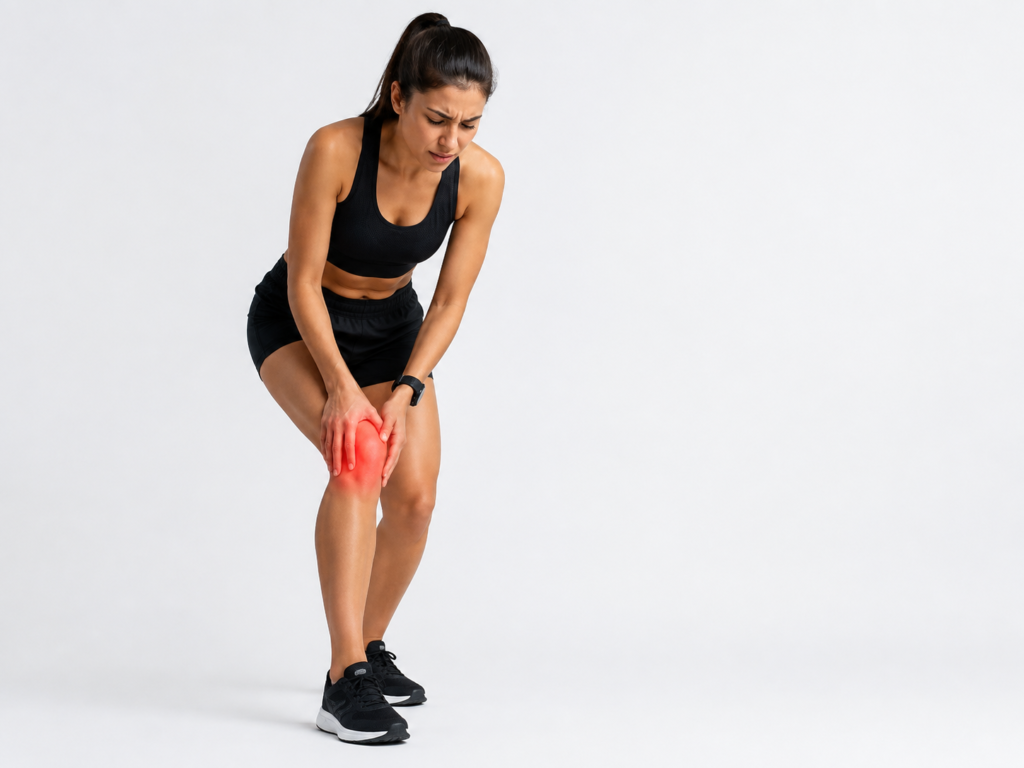
The location of your knee pain can provide useful clues. Pain around or behind the kneecap is commonly associated with patellofemoral pain — often called runner’s knee. Sharp pain on the outside of the knee may involve the iliotibial band, while very localised pain immediately below the kneecap can indicate patellar tendon involvement.
But knee pain does not automatically mean that running has damaged your knee.
Research has challenged the common belief that recreational running simply “wears out” the knee. A large systematic review and meta-analysis involving more than 125,000 people found a lower observed prevalence of hip and knee osteoarthritis among recreational runners than sedentary controls. This does not prove running prevents arthritis, but it certainly challenges the idea that recreational running inevitably destroys knee cartilage.
For many runners, a more useful concept is load versus capacity.
Has your running distance, speed, hill training or frequency increased beyond what your knee is currently prepared to tolerate?
In this guide we look at:
Pain location cannot provide a diagnosis by itself, but it is a useful starting point.
| Pain location | Possible causes (Other elements may be involved) |
|---|---|
| Around or behind the kneecap | Patellofemoral pain / runner’s knee |
| Immediately below the kneecap | Patellar tendinopathy |
| Outside of the knee | IT band-related lateral knee pain |
| Inside of the knee | Medial meniscus, medial joint, MCL or pes anserine-related pain |
| Back of the knee | Muscular, tendon or joint-related causes |
| Swollen after a twisting injury | Meniscal, ligament or other intra-articular injury |
The behaviour of the symptoms matters just as much as where they hurt.
A knee that gradually becomes uncomfortable after 50 minutes of running presents very differently from a knee that rapidly swells after a twisting injury.
Running places repeated load through the knee.
Every stride requires the quadriceps, hamstrings, calf and hip muscles to absorb and generate force while the knee joint itself repeatedly accepts load.
That is normal.
Loading a knee is not the same as damaging a knee.
A common pattern is that symptoms appear following a change in training, for example:
Importantly, the evidence does not support a simplistic rule such as “never increase mileage by more than 10%”.
A systematic review examining training-load changes and running-related injuries found some evidence linking sudden changes in distance, speed or frequency with injury, but overall evidence was limited.
So the question is not simply:
“Did I break the 10% rule?”
It is:
“Has my overall training demand changed faster than my body has adapted?”
That demand includes distance, speed, hills, frequency, strength training and recovery.
If your knee pain repeatedly returns when mileage increases, prevents you reaching your normal running distance or you are unsure whether the problem is runner’s knee, IT band pain or another condition, a running-specific assessment can help establish the likely cause.
Contact Stride Lab London to book a running physio assessment.
One of the most common explanations for pain around or behind the kneecap when running is patellofemoral pain.
You may hear this described as:
The pain is usually felt around or behind the patella.
Rather than pointing to one tiny painful spot, runners often cup a hand over or around the kneecap.
Symptoms can also occur with:
Patellofemoral pain used to be explained very simply.
Runners were often told:
“Your kneecap isn’t tracking properly.”
Or:
“Your VMO isn’t firing.”
Or:
“Your glutes are weak.”
Modern research suggests it is considerably more complicated.
Patellofemoral pain is generally regarded as multifactorial.
Training load, quadriceps capacity, hip strength, running mechanics, previous symptoms, recovery and individual anatomy may all contribute differently between runners.
There is no single biomechanical fault that explains every case.
That means good treatment should not start with trying to make every runner move identically.
A more useful question is:
What is making this runner’s patellofemoral joint sensitive, and what needs to change to increase its ability to tolerate running?
Exercise has some of the strongest evidence.
An international consensus statement on patellofemoral pain recommends exercise therapy and particularly supports combining hip-focused and knee-focused strengthening to improve pain and function.
Depending on the individual, exercises could include:
This is quite different from simply prescribing light resistance-band exercises indefinitely.
A runner preparing for a marathon needs the lower limb to tolerate thousands of loading cycles.
Rehabilitation therefore needs to become progressively challenging.
Often, some running can be maintained.
The answer depends on the severity and behaviour of the symptoms.
If you can run with:
then temporarily modifying rather than completely stopping running may be appropriate.
For example, a runner whose knee begins hurting after 50 minutes might temporarily reduce running to 30–35 minutes while strength and running tolerance improve.
The objective is not to continually test how much pain you can tolerate.
It is to create a manageable training stimulus that can gradually increase.
Sharp pain on the outside of the knee during running often raises suspicion of iliotibial band syndrome, commonly shortened to ITBS.
A classic presentation is:
The first part of the run feels completely normal.
Then, after a predictable distance, lateral knee pain begins.
The runner stops and the symptoms settle.
They try again a few days later — and the pain appears at roughly the same point.
A systematic review specifically examining IT band syndrome in runners found conflicting evidence regarding its causes, including uncertainty about the exact importance of hip strength and specific biomechanical characteristics.
This is important because IT band pain is frequently over-simplified.
Is the IT Band Rubbing Over the Knee?
Traditionally, ITBS was described as the IT band repeatedly rubbing backwards and forwards across the outside of the femur.
More recent research has challenged this simple friction explanation.
A peer-reviewed review of iliotibial band syndrome in runners discusses alternative mechanisms including compression of sensitive tissues around the lateral femoral region.
This means treatment should probably not revolve entirely around:
stretching the IT band + foam rolling + resting.
Instead, rehabilitation may involve:
Useful options may include:
3 sets × 8–12 repetitions each leg
A useful single-leg exercise involving the hip and knee while controlling the pelvis and lower limb.
3 × 6–10
Develops posterior-chain and single-leg capacity.
3 × 6–10
Provides progressive loading through both the hip and knee.
3 × 10–15
This can be performed side-lying, standing against resistance or using a cable.
These are examples rather than a universal IT-band programme.
What matters is progressive loading and eventually restoring the activity that actually causes the symptoms: running.
ery localised pain immediately below the kneecap may involve the patellar tendon.
Patellar tendinopathy generally produces load-related pain around the inferior pole of the patella.
It may be aggravated by:
A major clinical review on patellar tendinopathy diagnosis and load management describes two characteristic features:
Not indefinitely.
This is one of the most important differences between short-term symptom reduction and actual rehabilitation.
A 2022 clinical review of patellar tendinopathy concluded that load management combined with progressive tendon-loading exercise represents the most effective treatment approach.
A separate systematic review of load monitoring and therapeutic exercise also found exercise-based management can improve pain, strength and function.
The goal is therefore:
reduce excessive load
↓
introduce tolerable resistance
↓
progress tendon loading
↓
restore higher-rate loading
↓
return to normal running
rather than:
rest until pain disappears
↓
immediately return to previous training
↓
pain returns.
Pain on the medial or inside of the knee can have several possible causes.
These include:
The history provides important clues.
Pain that gradually develops following an increase in running volume is different from immediate pain after twisting the knee while the foot is planted.
The knee contains two menisci: the medial and lateral meniscus.
They contribute to load distribution, shock absorption and joint stability.
A traumatic meniscal injury can occur following rotation or twisting while the foot remains planted.
Possible symptoms include:
However, finding a meniscal tear does not automatically mean surgery is required.
This is an area where high-quality research has substantially changed management.
The five-year ESCAPE randomised controlled trial compared exercise-based physical therapy with arthroscopic partial meniscectomy in people with degenerative meniscal tears.
At five years, physiotherapy remained non-inferior to surgery for knee function.
There is also evidence in younger adults.
A randomised controlled trial involving people aged 18–45 with traumatic meniscal tears found early arthroscopic partial meniscectomy was not superior to a strategy of physiotherapy with the option of delayed surgery at two years.
This does not mean surgery is never appropriate.
A genuinely locked knee, certain displaced tears or significant persistent mechanical symptoms can require orthopaedic assessment.
But an MRI report containing the phrase “meniscal tear” does not automatically equal surgery.
For recreational runners, current research is reassuring.
A common belief is that every running stride removes a small amount of cartilage until eventually the knee “wears out”.
Human tissue does not behave like a car tyre.
Cartilage, bone, muscle and tendon are biological tissues that interact with mechanical loading.
A large systematic review and meta-analysis examining recreational and competitive running and osteoarthritis included 25 studies and more than 125,000 people.
The reported prevalence of hip or knee osteoarthritis was:
There are important limitations.
These observational findings do not prove that recreational running prevents osteoarthritis, and factors such as previous injury may influence the results.
But they clearly challenge the statement:
“Running wears out your knees.”
For some people, yes.
An osteoarthritis diagnosis does not automatically mean all running must stop.
Important factors include:
A runner who has exercised regularly for 20 years and experiences mild stable symptoms presents very differently from someone beginning running for the first time with a highly irritable knee.
Treatment needs to reflect the person rather than simply the X-ray.
Delayed symptoms are common.
You might complete a run comfortably but experience knee pain:
This doesn’t automatically mean you damaged the knee during the run.
Running creates a large cumulative loading dose.
A knee may tolerate each individual stride without symptoms but become sensitive after thousands of repetitions.
The response during the following 24 hours is therefore useful information.
If symptoms return close to baseline by the next day, the session may have been reasonably tolerated.
If the knee becomes increasingly painful, swollen or significantly more irritable for several days, the training dose may have been excessive.
A predictable pain threshold is particularly useful clinically.
Imagine:
0–30 minutes: no pain.
40 minutes: slight discomfort.
50 minutes: definite knee pain.
60 minutes: you need to stop.
This tells us your knee has considerable running capacity.
It simply does not currently tolerate the full 60-minute dose comfortably.
Instead of repeatedly running until pain forces you to stop, a more productive approach might be:
Pain at 50 minutes
↓
temporarily run 30–35 minutes
↓
progress lower-limb strength
↓
increase to 40 minutes
↓
increase to 45 minutes
↓
eventually restore 50–60+ minutes
The principle is:
build capacity rather than repeatedly testing the point of failure.
There is no single “best exercise”.
The programme should reflect the likely diagnosis, symptoms and runner’s current capacity.
For patellofemoral pain, useful exercises commonly include:
3 × 6–10 each side
3 × 8–12
3 × 8–12
This can be particularly useful for directly loading the quadriceps.
3 × 6–12
3 × 6–10
3 × 10–20
Calf capacity matters because the calf plays an important role in running propulsion and lower-limb force management.
The exact programme will vary according to irritability and physical capacity.
The important principle is progressive overload.
An exercise that was difficult in week one should usually become easier.
When that happens, resistance, range, repetitions, complexity or speed can progressively increase.
A runner cannot prepare for a marathon indefinitely using the same light resistance band.
Not automatically.
Hip muscles are important during running and improving hip strength can be useful.
Indeed, the international patellofemoral pain consensus supports combining hip and knee strengthening.
But this does not prove weak glutes caused the pain.
There is an important distinction between:
finding a weakness
and
proving that weakness caused an injury.
Pain itself can reduce muscle output.
Reduced activity after an injury can also lead to weakness.
So the more useful question is:
“Would increasing hip strength improve this runner’s overall running capacity?”
Often the answer is yes.
Sometimes running mechanics may influence knee loading.
Potentially relevant features include:
But there is no universal perfect running technique.
A runner should not automatically be told their knee hurts because:
Running analysis becomes most useful when a specific modification produces a meaningful change.
For example, some runners with patellofemoral pain may benefit from a modest increase in cadence.
A recent umbrella review of gait retraining for runners with patellofemoral pain found that strategies such as a 5–10% increase in cadence or softer-landing cues can modify certain biomechanical variables and may improve short-term symptoms in selected runners, although long-term evidence remains less certain.
This means gait retraining should be considered an adjunct, not a universal cure.
The question should be:
“Does this particular change help this particular runner?”
rather than:
“Does their running look perfect?”
Running analysis may be particularly valuable when symptoms:
At Stride Lab London, a 60-minute running assessment can include video and sensor-based running analysis, movement assessment and strength testing where appropriate.
The purpose is not simply to find biomechanical “faults”.
It is to determine whether anything measurable and modifiable appears relevant to your symptoms and running goals.
Repeatedly resting until symptoms settle and then returning directly to your old mileage can create a cycle of recurrence.
A running physio assessment can help establish what your knee currently tolerates and how to progressively rebuild the missing capacity.
There is no single answer that applies to every knee problem.
Complete rest is not automatically necessary.
For some gradual-onset running injuries, maintaining modified running can be appropriate.
You may potentially continue some running when:
It may be more sensible to reduce or stop the aggravating activity when:
The suspected diagnosis matters.
A mild patellofemoral presentation is very different from an acutely swollen knee following trauma.
Consider seeing a running physio when:
You do not necessarily need to wait until you are unable to run.
Earlier assessment can help interrupt the common cycle:
running
↓
pain
↓
complete rest
↓
symptoms improve
↓
immediate return to previous mileage
↓
pain returns.
The missing stage is often progressively rebuilding capacity between rest and full training.
Most gradual running-related knee pain is not an emergency.
However, prompt medical assessment is important if you develop:
A genuinely locked knee means the knee physically cannot fully straighten rather than simply feeling stiff or painful.
These presentations require a different approach from gradual-onset runner’s knee.
Usually not automatically.
Many running-related knee conditions are primarily diagnosed through:
Imaging can also identify abnormalities in people who have relatively few symptoms.
This is particularly relevant to meniscal and degenerative findings.
The ESCAPE randomised controlled trial is a good example of why scan findings need clinical context: people with degenerative meniscal tears achieved long-term outcomes with exercise-based physiotherapy that remained non-inferior to arthroscopic partial meniscectomy.
Imaging becomes useful when it answers a specific clinical question.
Ask:
“What decision will this scan help us make?”
rather than:
“My knee hurts — why haven’t I had an MRI?”
Return to running should progressively recreate the demands of the sport.
Identify how much activity and running the knee currently tolerates.
Progress:
Start below the previous symptom threshold.
Gradually extend comfortable running time.
Progress towards the normal number of weekly sessions.
Stage 6 — Reintroduce Speed and Hills
Running requires the knee to tolerate greater and more frequent loading than walking. It is therefore entirely possible for everyday walking to remain comfortable while the knee becomes symptomatic after repeated running strides.
Patellofemoral pain is usually managed conservatively, but symptoms can become persistent if the factors maintaining them are not addressed. Exercise and appropriate load management are generally central to rehabilitation.
There is no universal timeframe.
Recovery depends on:
This depends on the diagnosis and symptom behaviour. Mild stable discomfort may sometimes be compatible with modified running. Progressive pain, swelling, limping or deterioration in everyday function warrants greater caution.
There is no single best exercise. Current international consensus recommendations favour exercise therapy involving both the hip and knee.
Usually not initially. Patellofemoral pain is predominantly a clinical diagnosis. Imaging becomes more useful if the diagnosis is uncertain or the result would genuinely alter management.
Current observational evidence does not show recreational runners having a higher prevalence of hip and knee osteoarthritis than sedentary controls. A large systematic review and meta-analysis actually found lower observed OA prevalence in recreational runners, although this does not prove running prevents osteoarthritis.
If knee pain is stopping you from running normally, repeatedly appears once you reach a specific distance or returns whenever your marathon or half-marathon mileage increases, a running-specific assessment can help clarify why.
At Stride Lab London, the aim is not simply to examine the painful knee in isolation. Depending on your presentation, assessment may include:
The goal is not simply:
“stop running until it feels better.”
It is to understand:
Why is the knee hurting?
How much running can it currently tolerate?
What capacity needs to improve?
And how can you safely build back towards the running you want to do?
Whether you are trying to return to your local 5K, build towards a half marathon or complete marathon training, recurring knee pain does not have to mean indefinitely abandoning running.
Contact Stride Lab London to arrange a running physio assessment.
This article is intended for general educational purposes and does not replace individual medical or physiotherapy assessment. Seek urgent medical assessment for significant or progressive neurological symptoms, changes in bladder or bowel function, saddle numbness, significant trauma or other concerning symptoms.